
In the world of genealogy, there are researchers who have pin sharp focus on their goals, who hone their skills by smashing all the brick walls, whose trees are always sourced to the nth degree, whose reports are concise and erudite, and whose files are always in the right order.
I am not one of those researchers.
I would love to be, but my brain is more of the “small dog spotting a squirrel” persuasion. I dive down all the rabbit holes with glee, have 27 projects on the go at any moment, and have all these IDEAS! (see header image for some of the ideas bouncing around my head right now …)
I don’t think this is a bad thing.
Sure, I am unlikely to ever become a published author (deadlines!), and my own family tree will never, ever, ever, be anywhere close to complete (even to my standards of satisfaction). But I love my style of genealogy. It is fascinating, thrilling, delightful, and there is always something new to learn or discover.
I started with Southgate.
My name, and a family that had already been extensively researched by my dad. But then the internet showed me all manner of unrelated Southgates. They got up to shenanigans! So I started a one-name study as an excuse to investigate them.
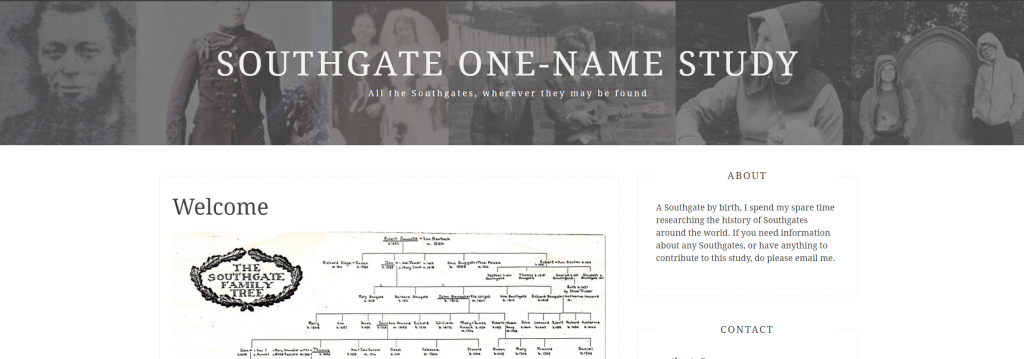
But one-name studies are rather slippery projects.
You think that all you need to do is “collect all instances of your chosen surname”, but that quickly becomes quite an expansive field of study. I began by collecting data, births, marriages, deaths, census records etc. So far, so good. There is plenty of data freely available on the internet these days and my spreadsheet became sprawling.
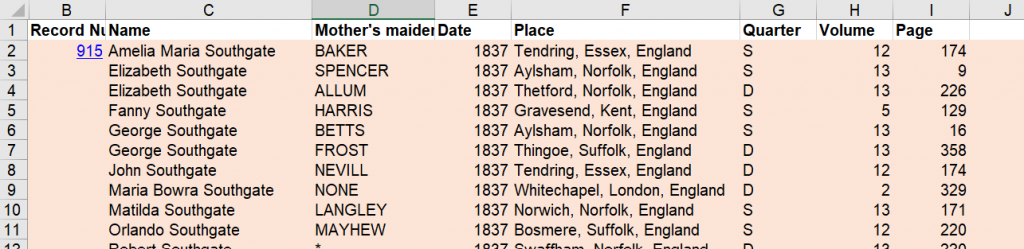
I then moved on to familial reconstruction – tracking back and forth through time to link together the names in my spreadsheet as family trees. This was great, and I am adding new info to my database regularly. But it was still just facts and links. My imagination wanted me to add more.
How could I bring life to my data?
While I was building family trees, I kept coming across titbits of information that didn’t add huge amounts of genealogical detail to my database, but were absolutely fascinating, nevertheless. Of course, records such as the newspaper articles below can be used to create timelines and lineages by adding dates and places to people’s lives, but it was the stuff beyond the headlines that interested me.
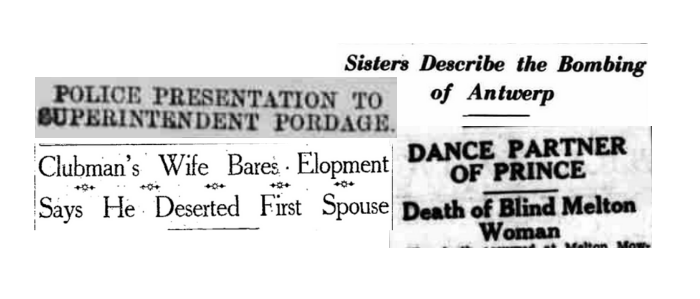
What was the process for suing a deserting husband in early 20th century California? How must the children of the fleeing sisters felt as they ran for their lives through wartorn Europe? What was life like for a blind teacher in Leicestershire, and how did that change when the Prince of Wales (Edward VIII) chose to dance with her? It was notable enough to be the focus of her obituary many years later. But what else did she do in her life that was overlooked in favour of this one event?
From these ideas, more sprang, half-formed …
I began to allow the headlines and other documents to take me beyond the facts and into the lives of my ancestors, deviating from tree building to wider social, historical and cultural context. This in turn has led me to all manner of unusual records, articles, books and documentaries, and given me a much better understanding of how my ancestors lived. I really feel that I am moving towards being able to properly tell their stories.
I have travelled far from the standard family history tools of births, marriages, deaths and censuses. I sometimes feel more like a genealogical detective than a family historian. I delve deep into musty old books (online right now, but soon in real life I hope!) and delicate documents, finding nuggets of information in the most unlikely of places.
And here I begin the next phase of my genealogical journey
It has not just been Southgates that have caught my attention. My own family and that of my husband have many stories to tell, and I “may” have found a new name to add to the one-name study databases … but more on that later.
A skill that I am slowly learning, and thoroughly enjoying, is writing. I think it is so important for family historians and genealogists to share their work, with others who may find it useful for their own research, with their families, with their kids to enthuse the next generation of researchers.
So here I will be hopefully doing just that. Shouting about my discoveries, discussing research resources and methods, and sharing my genealogical journey.
